
Banner Background

Understanding Mutual Funds

HomeInvestmentsSipUnderstanding Mutual Funds
Investments • Sip

Understanding Mutual Funds

WealthRoots Team
Aug 4, 2026
Understanding Mutual Funds

Understanding Mutual Funds - A Complete Beginner's Guide

What Are Mutual Funds?
A mutual fund is a financial vehicle that pools money accumulated from many investors to invest in securities such as stocks, bonds, money market instruments, and other assets. Think of it as a giant pizza. Instead of buying the entire pizza yourself (which can be very expensive), you and thousands of individuals buy small slices.

Mutual funds are managed by professional money managers (fund managers), who allocate the fund's assets and attempt to produce capital gains or income for the fund's investors. The portfolio is structured and maintained to match the investment objectives stated in the fund's prospectus.

Types of Mutual Funds

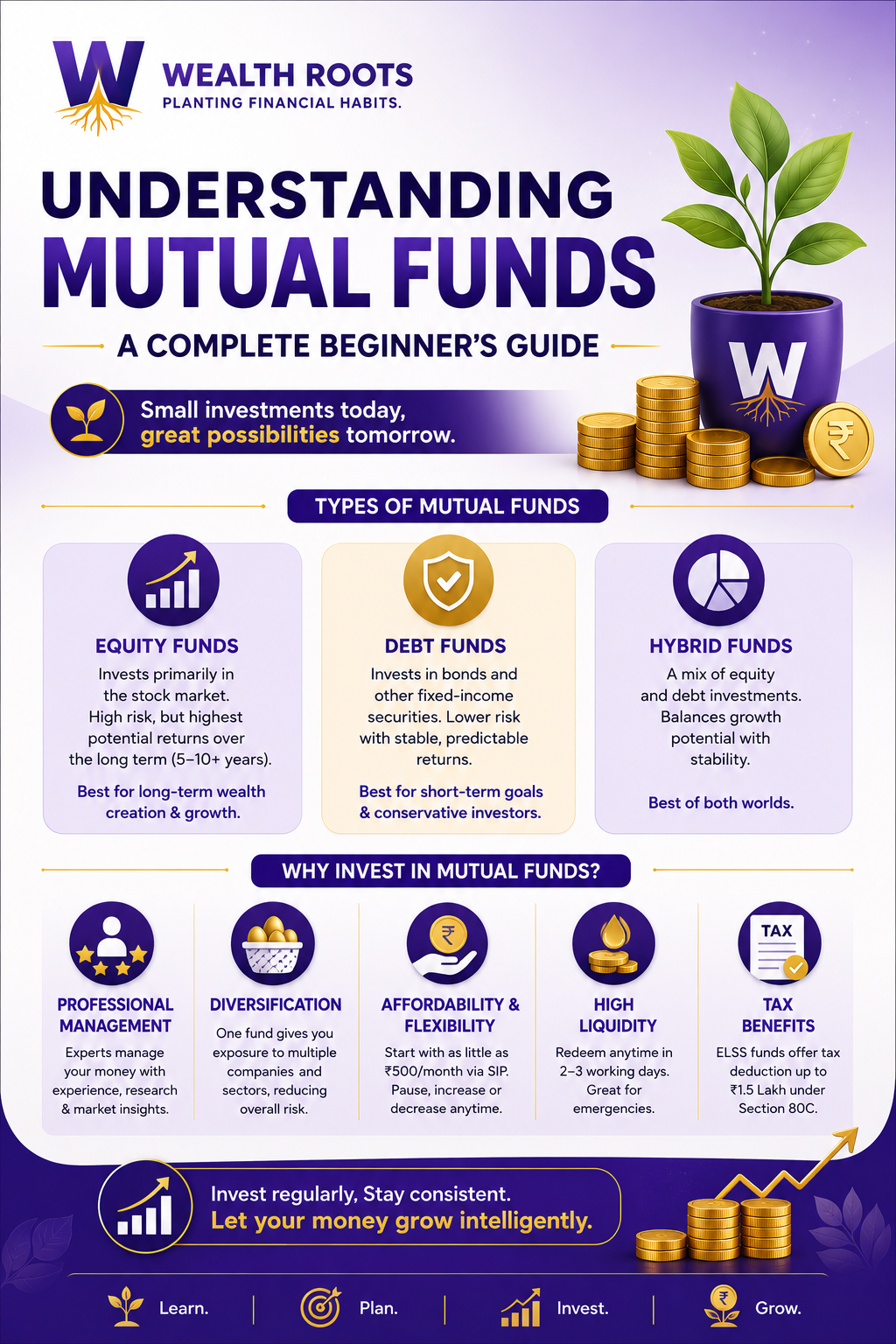
  • Equity Funds: These invest primarily in the stock market. They carry high risk but historically offer the highest potential returns over the long term (5-10+ years). They are perfect for long-term wealth creation, retirement planning, or a child's education.

  • Debt Funds: These invest in fixed-income securities like government bonds, corporate bonds, and treasury bills. They are much safer than equity funds and offer stable, predictable returns. They are ideal for short-term goals (1-3 years) or for conservative investors.

  • Hybrid Funds: These are a mix of both equity and debt. They aim to offer the best of both worlds: the growth potential of equity and the stability of debt.

Why Should You Invest in Mutual Funds?

  1. Professional Management: You don't need to track the stock market daily, analyse balance sheets, or worry about market timing. Experts with years of experience and powerful research teams do the heavy lifting of buying, selling, and monitoring investments for you.

  2. Diversification: Don't put all your eggs in one basket. Buying one mutual fund unit instantly gives you a small stake in dozens of different companies across various sectors (like IT, Banking, Pharma). If one sector underperforms, the others can balance it, significantly reducing your overall risk.

  3. Affordability & Flexibility: You don't need lakhs of rupees to start investing. You can begin your investment journey with as little as ₹500 per month through a Systematic Investment Plan (SIP). You can also stop, increase, or decrease your SIP amount without any massive penalties.

  4. High Liquidity: Unlike real estate or fixed deposits with lock-in periods, most open-ended mutual funds allow you to redeem your money anytime. It takes just 2-3 working days for the money to hit your bank account, making it great for emergencies.

  5. Tax Benefits: Mutual funds such as Equity Linked Savings Schemes (ELSS) offer tax deductions of up to ₹1.5 Lakh under Section 80C of the Income Tax Act.

Conclusion
Mutual funds are one of the most transparent, regulated, and efficient ways for beginners to step into the world of investing. By starting early, choosing the right fund, and staying consistent with your SIPs, you can harness the magical power of compounding to build massive, life-changing wealth over time.


Understanding Mutual Funds - A Complete Beginner's Guide

What Are Mutual Funds?
A mutual fund is a financial vehicle that pools money accumulated from many investors to invest in securities such as stocks, bonds, money market instruments, and other assets. Think of it as a giant pizza. Instead of buying the entire pizza yourself (which can be very expensive), you and thousands of individuals buy small slices.

Mutual funds are managed by professional money managers (fund managers), who allocate the fund's assets and attempt to produce capital gains or income for the fund's investors. The portfolio is structured and maintained to match the investment objectives stated in the fund's prospectus.

Types of Mutual Funds

  • Equity Funds: These invest primarily in the stock market. They carry high risk but historically offer the highest potential returns over the long term (5-10+ years). They are perfect for long-term wealth creation, retirement planning, or a child's education.

  • Debt Funds: These invest in fixed-income securities like government bonds, corporate bonds, and treasury bills. They are much safer than equity funds and offer stable, predictable returns. They are ideal for short-term goals (1-3 years) or for conservative investors.

  • Hybrid Funds: These are a mix of both equity and debt. They aim to offer the best of both worlds: the growth potential of equity and the stability of debt.

Why Should You Invest in Mutual Funds?

  1. Professional Management: You don't need to track the stock market daily, analyse balance sheets, or worry about market timing. Experts with years of experience and powerful research teams do the heavy lifting of buying, selling, and monitoring investments for you.

  2. Diversification: Don't put all your eggs in one basket. Buying one mutual fund unit instantly gives you a small stake in dozens of different companies across various sectors (like IT, Banking, Pharma). If one sector underperforms, the others can balance it, significantly reducing your overall risk.

  3. Affordability & Flexibility: You don't need lakhs of rupees to start investing. You can begin your investment journey with as little as ₹500 per month through a Systematic Investment Plan (SIP). You can also stop, increase, or decrease your SIP amount without any massive penalties.

  4. High Liquidity: Unlike real estate or fixed deposits with lock-in periods, most open-ended mutual funds allow you to redeem your money anytime. It takes just 2-3 working days for the money to hit your bank account, making it great for emergencies.

  5. Tax Benefits: Mutual funds such as Equity Linked Savings Schemes (ELSS) offer tax deductions of up to ₹1.5 Lakh under Section 80C of the Income Tax Act.

Conclusion
Mutual funds are one of the most transparent, regulated, and efficient ways for beginners to step into the world of investing. By starting early, choosing the right fund, and staying consistent with your SIPs, you can harness the magical power of compounding to build massive, life-changing wealth over time.

Request a Callback

Leave your details below and our team will get back to you shortly.

Understanding Mutual Funds | WealthRoots Blog