Good Debt vs. Bad Debt — A Distinction That Can Change Your Financial Life
Introduction
Somewhere along the way, most of us were taught that debt is bad. Full stop. Borrow nothing, owe no one, stay clear of EMIs, and loans and credit cards — that was the wisdom passed down at dining tables and in frugal family conversations across India.
And it is not entirely wrong. Debt, managed carelessly, can quietly dismantle a financial life that took years to build. But the full picture is more nuanced — and more useful — than a blanket prohibition on borrowing.
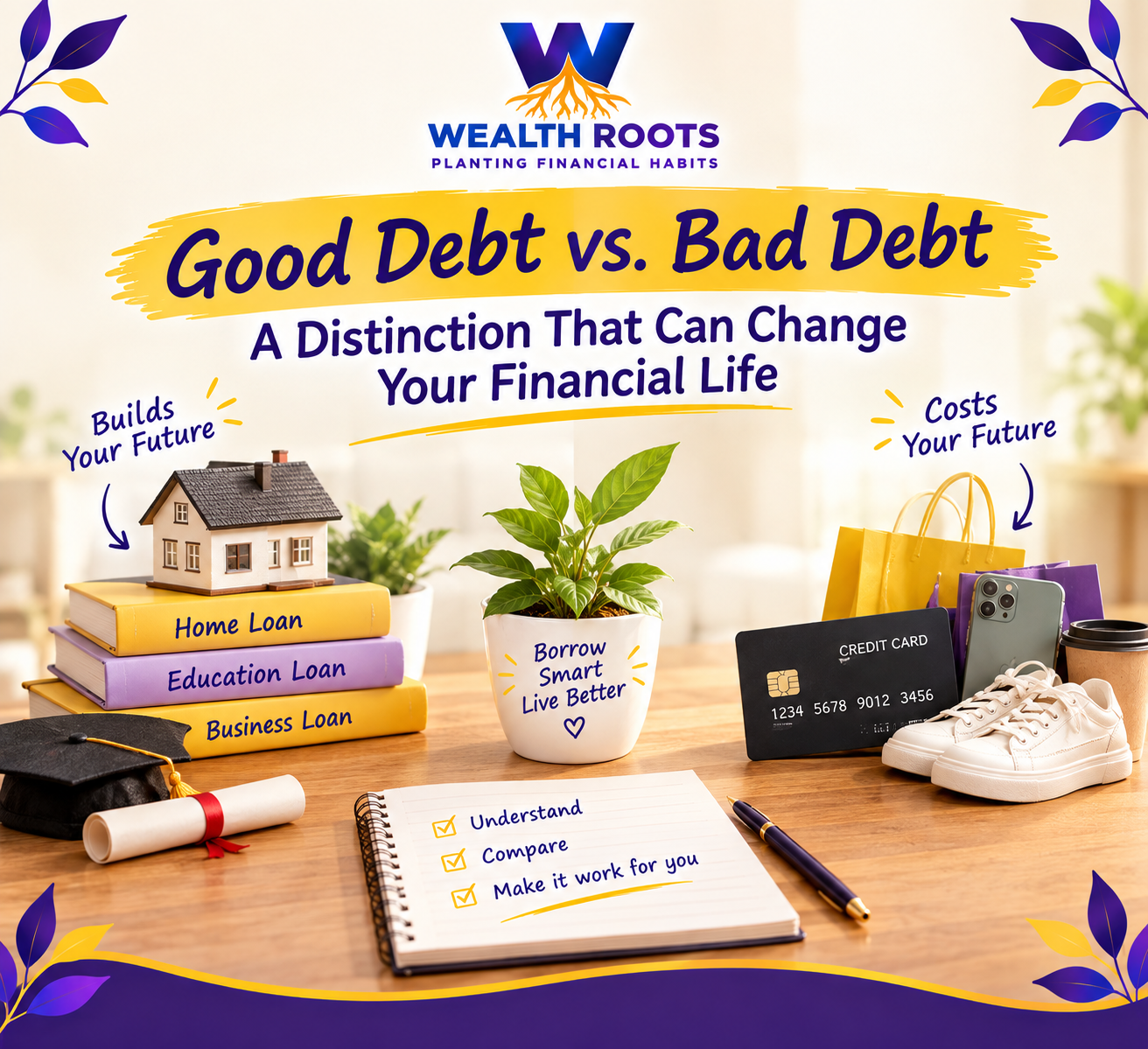
Because here is the truth that changes how you think about money: not all debt is equal. Some debt builds your future. Some debt quietly eats it. The difference between the two is one of the most important distinctions in all of personal finance — and most people never learn to make it.
This blog is about making that distinction clearly. Not to encourage you to borrow more, but to help you borrow smarter — and to recognise, when debt is already part of your life, which kind deserves your urgency and which kind can be managed with patience.
Let Us Start with What Debt Actually Is
Debt is simply borrowed money that must be repaid — usually with interest. What makes it good or bad is not the act of borrowing itself, but the use of the borrowed money and whether the cost of borrowing is outweighed by the benefit it creates.
Think of it this way. If you borrow money to buy something that grows in value or generates income — a home that appreciates, an education that increases your earning power, a business that generates profit — the debt is potentially working in your favour. If you borrow money to buy something that loses value the moment you use it — a holiday you put on a credit card, a phone you could not afford, a lifestyle upgrade funded by a personal loan — the debt is working against you.
That, at its core, is the distinction between a good debt and a bad debt.
Good Debt — Borrowing That Builds
HOME LOAN
A home loan is the most widely understood example of good debt in India — and for good reason. When you take a home loan to purchase property in a growing urban corridor, you are using borrowed money to acquire an asset that has historically appreciated overtime.
Yes, the interest paid over 20 years is significant — total interest on a ₹48 lakh loan at 8.5% over 20 years amounts to approximately ₹52–54 lakhs. But what you are building in parallel is an asset: a home that belongs to your family, one that can be inherited, that protects you from rental volatility, and that — in most Indian cities — has delivered real appreciation over long holding periods.
The key qualifier: a home loan is good debt when the property is purchased at a fair price, in a location with genuine demand, and the EMI fits comfortably within your budget without crowding out savings and investments. When it stretches you so thin that nothing goes into your SIP or emergency fund, it tips from manageable to dangerous.
EDUCATION LOAN
An education loan that funds a degree with strong employment prospects — engineering, medicine, an MBA from a recognised institution, a professional certification in a growing field — is another form of debt that builds future earning power.
The logic is simple: if the education increases your lifetime income by more than the total cost of the loan, the borrowing has created a net positive. A ₹10 lakh education loan that results in a salary 30–40% higher than you would otherwise have earned is not a burden. It is leverage — the same principle that makes investing work, applied to human capital.
An education loan crosses into problematic territory when they fund courses with low employability or when the repayment burden arrives before stable income does. The debt itself is not the issue. The return on that debt is.
BUSINESS LOAN
Borrowing to start or grow a business — when the business has a credible plan, a real market, and a realistic path to generating returns above the cost of the loan — falls into the good debt category. Entrepreneurs throughout history have used borrowed capital to build enterprises that created wealth for themselves and employment for others.
The discipline required here is rigorous: a business loan must be supported by a plan, not just a hope. And the personal financial consequences of business failure must be considered before signing any personal guarantee.
Good debt is a tool. Like any tool, it builds something useful in the right hands and causes damage in the wrong ones. The tool is not the problem. The plan is.
Bad Debt — Borrowing That Costs
CREDIT CARD REVOLVING BALANCES
Here is a number that should stop you mid-swipe: most credit cards in India charge interest rates between 36% and 42% per annum on unpaid balances. That is not a typo. If you spend ₹20,000 on your credit card and pay only the minimum amount due each month, the interest accumulating on that balance increases at a rate that would make your best mutual fund blush — in the wrong direction.
Credit cards are not bad instruments. Used correctly — spending within your means, paying the full balance every month, earning reward points on purchases you would make anyway — they are genuinely useful. The trap is the revolving balance: carrying unpaid credit card debt from one month to the next, where interest compounds at rates that no investment can outrun.
If you have credit card debt today, it is the most expensive debt in your financial life. Clearing it should come before any investment except your emergency fund.
PERSONAL LOANS FOR LIFESTYLE PURCHASES
Personal loans are among the most freely available financial products in India today — disbursed within hours, requiring minimal documentation, and marketed aggressively for every conceivable purpose. And they carry interest rates that typically range from 12% to 24% per annum.
Using a personal loan to fund a holiday, a wedding beyond your means, a phone upgrade, or home décor is borrowing money at high interest to buy things that deliver zero financial return. You are paying significantly more than the cost of the item for something that will be worth far less — or nothing at all — by the time the loan is repaid.
This does not mean a personal loan is never appropriate. A genuine emergency — a medical expense when your health insurance falls short, a critical home repair — can justify one. The question to ask is always: what I am buying with this loan going to be worth more to me than the total cost of borrowing?
BUY NOW PAY LATER (BNPL) AND APP-BASED MICROLOANS
The rise of BNPL risks — Buy Now Pay Later schemes embedded in every shopping app — has made debt dangerously invisible. The purchase feels free. The repayment arrives quietly in instalments. And the total cost, spread across four or six payments, rarely registers borrowing.
For young Indians and first-time earners especially, BNPL has normalised a relationship with debt that bypasses the very moment of financial reckoning — the pause before a purchase, when you ask: can I actually afford this? — that good financial habits are built on.
BNPL used for genuinely necessary purchases, repaid on time, with no interest, is manageable. Used habitually, across multiple platforms, for discretionary spending, it quietly accumulates into a debt burden that is invisible until it is not.
The most dangerous debt is the kind that does not feel like debt — the easy EMI, the BNPL checkout, the credit card swipe that becomes a habit before it becomes a problem.
How to Tell the Difference in Real Life
In theory, the debt good and bad distinction is clear. In real life, the lines blur — particularly when financial pressure makes borrowing feel necessary even when it is not.
Here are three questions to ask before taking on any debt:
What is this debt funding? An asset that grows or an experience or item that will be gone before the loan is repaid?
What is the true cost? Not the EMI — the total amount repaid over the loan tenure, including all interest. Is what you are buying worth that total cost?
What does this EMI do to my financial plan? Does it leave room for my emergency fund, my SIP, my insurance premiums? Or does it crowd out the savings that protect me if something goes wrong?
If a debt passes all three questions, it may well be worth taking on. If it fails any one of them, pause — and ask whether there is another way.
Managing Debt You Already Have
If you are reading this with existing debt — a home loan, a personal loan, a credit card balance — the distinction between good and bad still matters, because it tells you which debt to prioritise.
The debt avalanche method says: list all your debts by interest rate, highest to lowest, and direct every extra rupee toward the highest-rate debt first while paying minimums on the rest. Mathematically, this is the fastest and cheapest path out of debt.
The debt snowball method says: list debts by outstanding balance, smallest to largest, and clear the smallest one first for the psychological momentum of an early win, regardless of interest rate.
Both strategies work. The best one is the one you will actually follow. What matters most is not which method you choose — it is that you choose one, and that the high-interest bad debt goes first.
Your home loan, with its relatively low rate and the asset it is building, can be managed on schedule. The credit card balance at 40% interest cannot wait.
The Bottom Line
Debt is not the enemy. Uninformed debt is.
A home loan that fits your income and builds an asset, an education loan that funds a career, a business loan backed by a real plan — these are forms of borrowing that can genuinely accelerate wealth creation. A credit card balance rolling over at 40% interest, a personal loan for a holiday, a BNPL habit that has quietly accumulated across six apps — these are forms of borrowing that quietly dismantle the financial life you are trying to build.
Knowing the difference is not a minor financial skill. It is one of the most consequential distinctions a person can make with their money — and one of the clearest markers between a financial life that progresses and one that perpetually treads water.
Borrow with intention. Repay with urgency where urgency is warranted. And before every loan, every EMI, every BNPL checkout — ask the one question that separates good debt from bad: is this building something, or just consuming it?
The goal is not to avoid all debt. It is to make sure every rupee you borrow is working harder for you than it is costing you.