
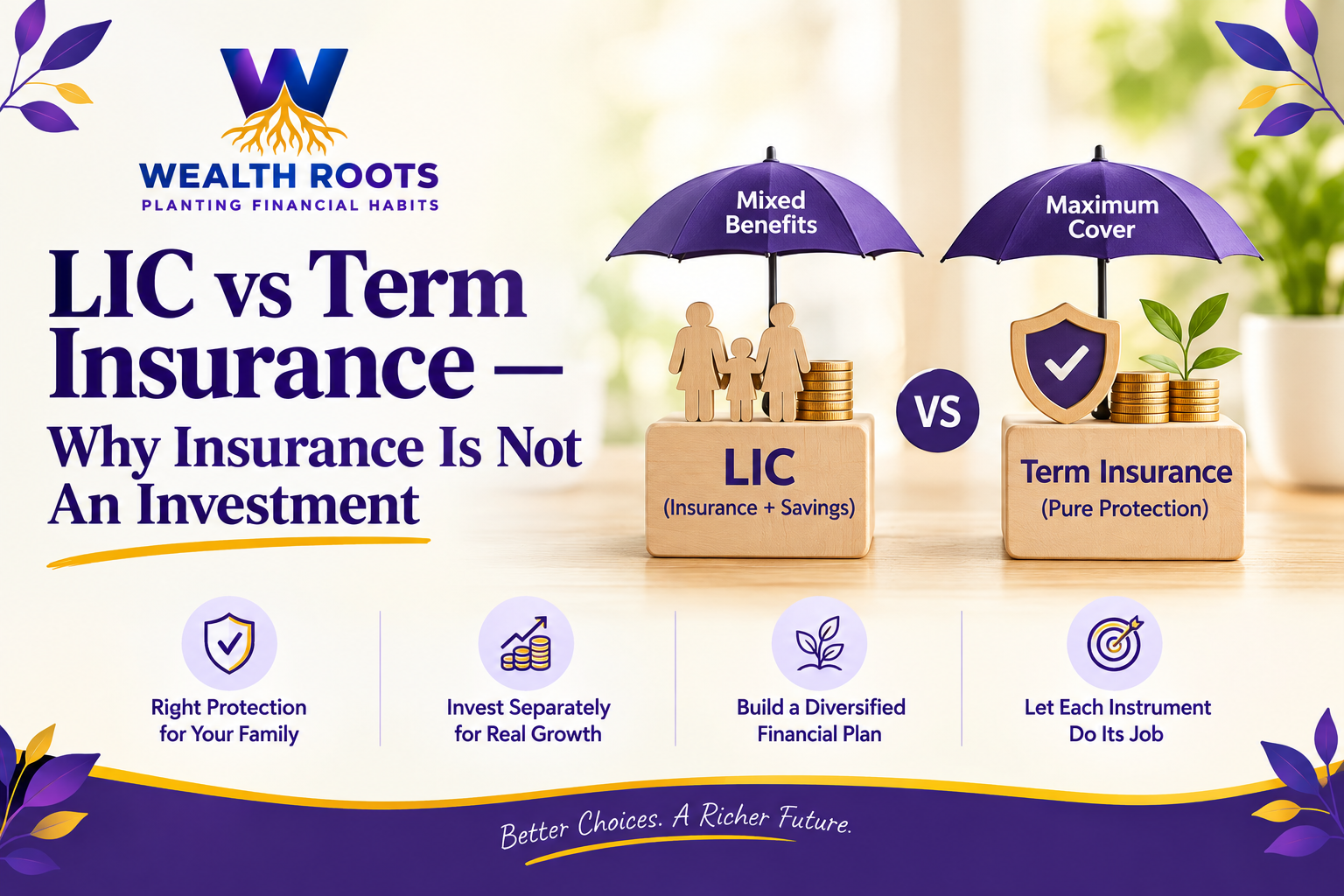
LIC vs Term Insurance — Why Insurance Is Not An Investment
Introduction
There is a conversation that almost every Indian has had with a relative, a neighbour, or a well-meaning family friend at some point. It usually goes something like this: "Take the LIC policy. You pay the premium, and when it matures, you get your money back. It is insurance and savings — two benefits in one."
It sounds sensible. It sounds like a smart deal. And for decades, millions of Indian families believed it was — because nobody told them otherwise.
But here is the financial truth that this advice consistently leaves out: when a product tries to do two things at once — protect your family and grow your money — it almost always does both poorly. And the cost of that compromise, measured over a lifetime, can run into lakhs of rupees.
This blog is about understanding that cost clearly — and making a better choice.
The Two Jobs of a Financial Plan
Before comparing policies, it helps to understand that protection and investment are fundamentally different jobs, and they work best when kept separate.
Protection's job is to replace your income if you are no longer alive to earn it. It is not about returns. It is about ensuring that your family — your spouse, your children, your dependents — can continue to live, pay rent, fund education, and meet daily needs without your salary. For this job, the metric that matters is - how large is the cover relative to the premium I pay?
An investment's job is to grow your money over time, ideally at a rate that beats inflation and builds long-term wealth. For this job, the metric that matters is - what are my actual returns, net of charges and taxes?
When you understand these as two separate jobs, it becomes immediately clear why a single product claiming to do both is a red flag — not a value proposition.
What Are Endowment and Money-Back Plans?
LIC and other traditional life insurers offer a range of plans that combine insurance with savings, broadly called endowment plans or money-back plans. These are the policies most commonly sold in India and most frequently misunderstood as investments.
Here is how they typically work: you pay a premium every year for a fixed term — say 20 or 25 years. At the end of that term, if you are alive, you receive a maturity benefit (your premiums returned, plus bonuses). If you die during the term, your nominee receives a death benefit. Some plans also pay out at intervals during the policy term — these are money-back plans.
On the surface, this sounds reassuring. You pay in, you get something back either way. But when you examine the numbers carefully, the picture changes.
The question to ask any insurance-cum-investment product is not 'do I get money back?' It is 'what is my actual return on this money, compared to what I could have earned elsewhere?'
The Numbers Behind the Policy
Let us examine a typical endowment scenario. Assume a 30-year-old buys an endowment plan with a sum assured of ₹10 lakhs, paying a premium of approximately ₹40,000 per year for 20 years.
Total premium paid over 20 years: ₹8 lakhs. Maturity benefit typically received (including bonuses): approximately ₹14–16 lakhs, depending on the insurer's declared bonus rates.
That sounds like a gain — until you calculate the actual rate of return. Most endowment plans, when the internal rate of return (IRR) is calculated, deliver approximately 4–5.5% annually. After accounting for inflation, the real return is often 0–1%.
Now consider what that same ₹40,000 per year could have done, split differently:
₹8,000–10,000 per year buys a term insurance plan with ₹1 crore cover for a 30-year-old — ten times the protection at a fraction of the cost
The remaining ₹30,000–32,000 per year invested in a mutual fund SIP at 12% annual returns over 20 years builds a corpus of approximately ₹2.9 crore
Compare that to ₹14–16 lakhs from the endowment plan. The difference — driven purely by the power of compounding applied to better-returning instruments — is the real cost of mixing insurance with investment.
Term Life Insurance — Pure Protection, Maximum Cover
A term insurance plan does exactly one thing: it pays your nominee a large, predetermined sum if you die during the policy term. If you survive the term, no maturity benefit is paid — because that is not its job. Its job is protection, and on that single metric, it is extraordinarily effective.
WHY TERM INSURANCE WORKS
₹1 crore of life cover available for a 30-year-old non-smoker at ₹700–1,000 per month — affordable at every income level
Cover can be extended to age 75 or 85 — ensuring protection through a family's most financially vulnerable decades
Premium is fixed for the entire policy term — no surprises, no escalating costs
Payout to nominee is tax-free under Section 10(10D) of the Income Tax Act
Riders available for critical illness, accidental disability, and waiver of premium — tailoring protection to your specific risks
WHO NEEDS TERM INSURANCE
Anyone with financial dependents — a spouse, children, ageing parents, or anyone whose lifestyle depends on your income
Home loan or EMI holders — so debt does not become a burden on the family
Business owners whose family's security is tied to their personal earning capacity
The Thumb Rule: your term cover should be at least 10–15 times your annual income. A 35-year-old earning ₹8 lakhs per year should carry a minimum of ₹80 lakhs to ₹1.2 crore in term cover.
Endowment / Money-Back Plans — Where to Be Careful
This is not an argument that endowment plans are worthless — it is an argument that they are frequently misrepresented and misused. Here is when they may have a limited role:
As a forced savings mechanism for individuals with very low financial discipline who would otherwise spend all their discretionary income
For extremely conservative investors who cannot tolerate any market risk and want guaranteed (if low) returns
As a small supplement to an already well-constructed financial plan — not as its centrepiece
WHAT TO WATCH OUT FOR
Agents earning high commissions on endowment sales — misaligned incentives often drive recommendations
Bonus rates that are not guaranteed — illustrated returns may not match actual payouts
Lock-in and surrender charges make early exit expensive if your needs change
The illusion of 'getting money back' masks poor real returns after inflation
Term life insurance vs. endowment plan is not a close contest when pure protection is the goal. One costs less, covers more, and leaves the rest of your money free to grow.
A Note on Regulation and the Role of IRDAI
The Insurance Regulatory and Development Authority of India (IRDAI) oversees all insurance products sold in India and has made significant strides in improving transparency — including requiring insurers to clearly disclose the internal rate of return on traditional plans and introducing benefit illustration norms that show both guaranteed and non-guaranteed components.
Despite this, the responsibility to ask the right questions remains with the buyer. Before signing any insurance policy, always ask: What is the IRR on this plan? How does it compare to a term plan plus a separate investment? If the agent cannot answer clearly, that is itself an answer.
The Right Framework: Separate and Specialise
The principle that makes financial plans work is specialisation. Each rupee should have a clear job assigned to it — and the instrument it is placed in should be the best available tool for that specific job.
For a family building a sound financial plan, this translates simply:
Protection: Term life insurance covering 10–15x annual income + health insurance for the family
Long-term wealth creation: Mutual funds SIP in equity funds for inflation-beating returns over 10–20 years
Tax-efficient savings: PPF and NPS India — both serve the retirement corpus with strong tax benefits under 80C
Short-term safety: Fixed Deposits and liquid funds for the emergency fund and near-term goals
This separation — protection in one bucket, investment in another — is what the 4 pillars of financial literacy look like in practice. Each pillar has its own instrument. None is asked to do double duty.
The Bottom Line
LIC is not the villain of this story. LIC has insured crores of Indian families, paid claims faithfully, and introduced the concept of financial planning to a generation that had no other entry point. The institution deserves its place in India's financial history.
But the product structure of endowment and money-back plans — mixing insurance and investment in a way that does both inefficiently — is worth questioning, especially when better alternatives now exist for every part of the equation.
Buy term insurance for protection. Invest separately for wealth. Let each instrument do what it was designed to do — and let the power of compounding work on properly invested money, not on a policy that returns 4% after 20 years.
Insurance is not an investment. It is a promise that the people who depend on you will be protected, no matter what. Keep that promise with the right tool.